Almost every traveler I guide goes home with a carpet, or at least spends a long time looking at one. I understand why. A Moroccan carpet is not just something to put on the floor. Most of them were woven by Amazigh (Berber) women, by hand, often over several months, and each one carries a little of the weaver's life and of her village. No two are exactly the same.
Where they come from
Weaving in Morocco goes back thousands of years. In the Atlas Mountains, carpets were first made for very practical reasons: to keep warm in winter, to sleep on, to divide the space inside a tent. Mothers taught their daughters, and the patterns were kept in memory, never drawn on paper.
The cities had their own story. Fez was a great carpet center in the Middle Ages, with dozens of dye workshops in its medina. Rabat developed a more formal, city style, with a plain center, medallions and flowers along the borders.
In the 20th century, European designers like Le Corbusier fell in love with the thick, simple Berber rugs and put them in their modern homes. That is a big part of why Moroccan carpets became so famous abroad.
The styles you will see in the souks
- Beni Ourain: the cream carpet with black or brown lines and diamonds that everyone recognizes. Very thick and soft, made from undyed sheep's wool in the Middle Atlas.
- Azilal: from the High Atlas. A light background with bright, free shapes in red, blue, yellow and green. Joyful and full of personality.
- Beni Mguild: deep reds, blues and purples, with diamonds and several borders. Warm and heavy, perfect for a cold floor.
- Boucherouite: my favorite story. Women weave them from strips of old clothes and recycled fabric, so they are colorful, creative and never repeated.
- Kilim (hanbel): flat-woven, without pile. Light, thin and easy to carry home, often with stripes and fine geometric bands.
- Taznakht: from the Anti-Atlas, south of Ouarzazate. Rich saffron, red and orange tones, often with a mix of flat weave and pile.
- Rabat: the city carpet: dense, short pile and a formal design, closer to what people imagine as an "Oriental" carpet.
How a carpet is made
The weaver stretches vertical threads, the warp, on a loom. Then she ties small knots of wool around them, row after row, and locks each row with horizontal threads, the weft. Berber carpets are usually knotted more loosely than Persian ones, which is why they feel so soft and generous under your feet.
Traditional colors come from plants: henna for orange-red, madder for red, saffron and pomegranate for yellow, indigo for blue. These natural dyes fade gently over the years, and many people love carpets even more as they age.
Reading the symbols
Berber carpets speak their own language, but every tribe, and sometimes every weaver, gives it her own meaning. So take these as the common readings, not strict rules:
- The diamond: the woman, fertility and protection. You will see it everywhere.
- A diamond with a dot in the middle: the eye that protects against the evil eye.
- Zigzags: water, rivers and the path of life.
- The cross or X: protection, or two lives meeting.
- A shape that "breaks" the pattern: not a mistake. Often it is the weaver's personal mark.
When we visit a cooperative, I always encourage you to ask the women themselves what their carpet means. Their answers are often far more beautiful than any book.
The women behind the cooperatives
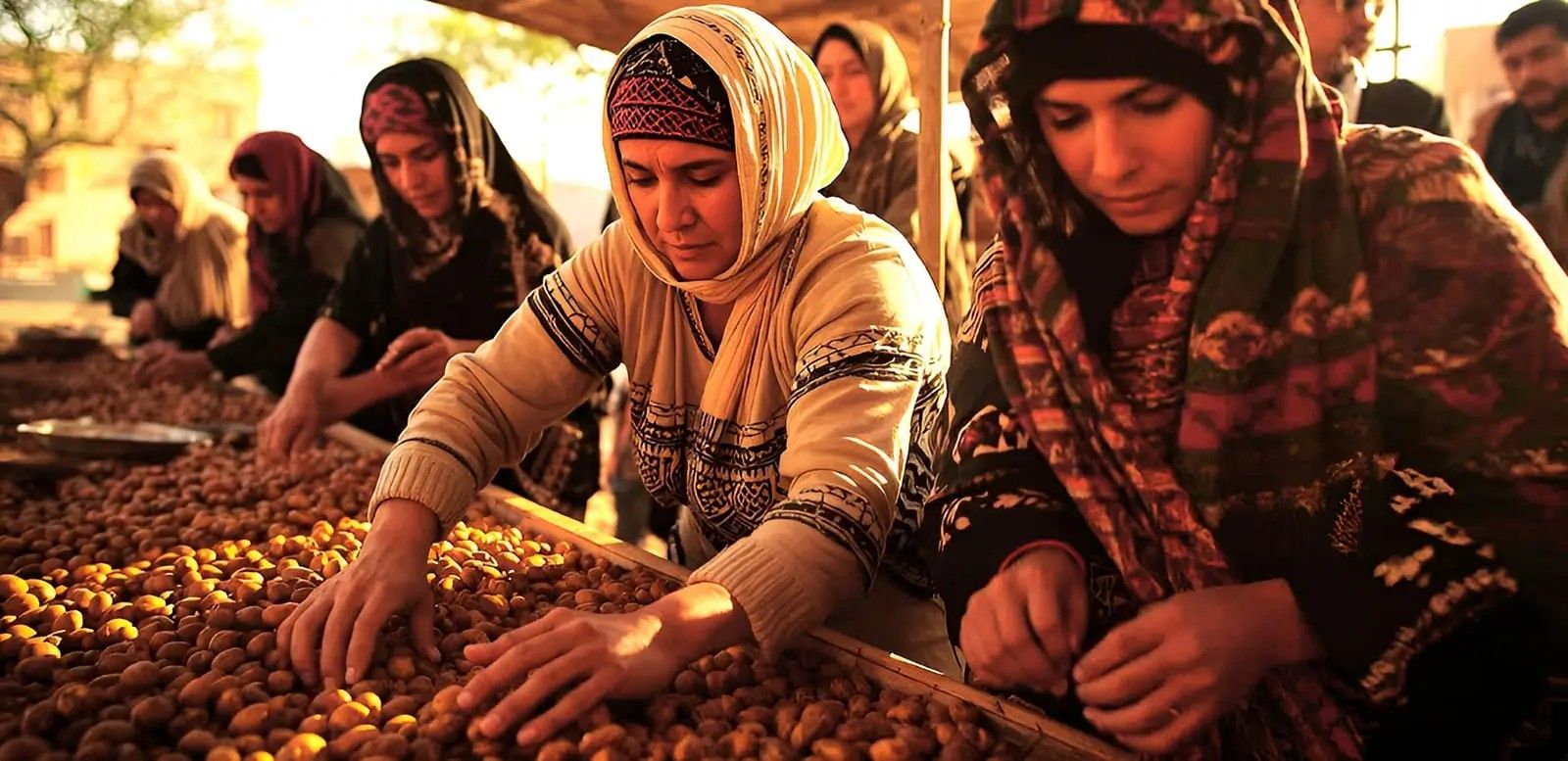
When we visit a carpet cooperative, I want you to know who you are meeting. Many of these cooperatives were created by women, and a large number of the weavers are divorced or widowed. For many of them, weaving is not a hobby. It is how they feed their children, pay for school and keep their families together.
In the villages, a woman who loses her husband, or whose marriage ends, can suddenly find herself alone with no income. By joining forces in a cooperative, these women share the looms, buy wool together and sell their carpets as a group. They set their own prices, earn a fairer share than they would through middlemen, and support one another, in work and in life.
When you sit with them, you understand that every carpet holds more than a pattern. It holds months of patience, and very often the courage of a mother who decided to stand on her own. Buying directly from a women's cooperative is one of the most meaningful ways to bring a piece of Morocco home: your money goes straight to the women who made it.
If this matters to you, tell me before your trip. I will include a cooperative in your journey and give you time to talk with the weavers, with me as your translator.
How to choose a good one
You do not need to be an expert. These simple checks already help a lot:
- Turn it over. On a hand-knotted carpet, you can see the pattern clearly on the back, and the knots are a little irregular. A perfectly regular back, or a glued fabric backing, usually means machine-made.
- Look at the fringes. On a hand-made carpet, they are the ends of the warp threads, not a strip sewn on afterward.
- Touch the wool. Good wool feels soft, springy and slightly oily. If it sheds a lot or feels like plastic, be careful.
- Test the colors. Rub a damp white tissue on them. A little variation in tone is normal and beautiful; strong bleeding is not.
- Lay it flat. Small irregularities are part of the charm, but the carpet should lie flat.
- Ask questions. Where was it made, by whom, roughly when? "Vintage" pieces cost more, so look for real signs of age.
And yes, you will bargain. It is part of the culture, and it should be a friendly conversation, usually over a glass of mint tea. Take your time, compare a few shops, and never feel that you have to buy.
Taking it home
Many shops can fold, wrap and ship your carpet abroad. Ask for a written receipt with the price, the size and the delivery address. Smaller carpets and kilims often fit in your luggage, but thick wool carpets are heavy, so check your airline's weight limits, and your country's customs rules, before you decide.
At home, vacuum gently without the brush, turn the carpet now and then so it fades evenly, and blot any spill with cold water instead of rubbing. A new wool carpet sheds a little at first. That is normal, and it stops.
Discover them with me
On my artisan and shopping tours, I take you to workshops and women's cooperatives where you can watch the weavers at work, learn to read the patterns and compare quality calmly, with no pressure at all. If a carpet speaks to you, wonderful. If not, you will still leave knowing much more about the women who keep this art alive.