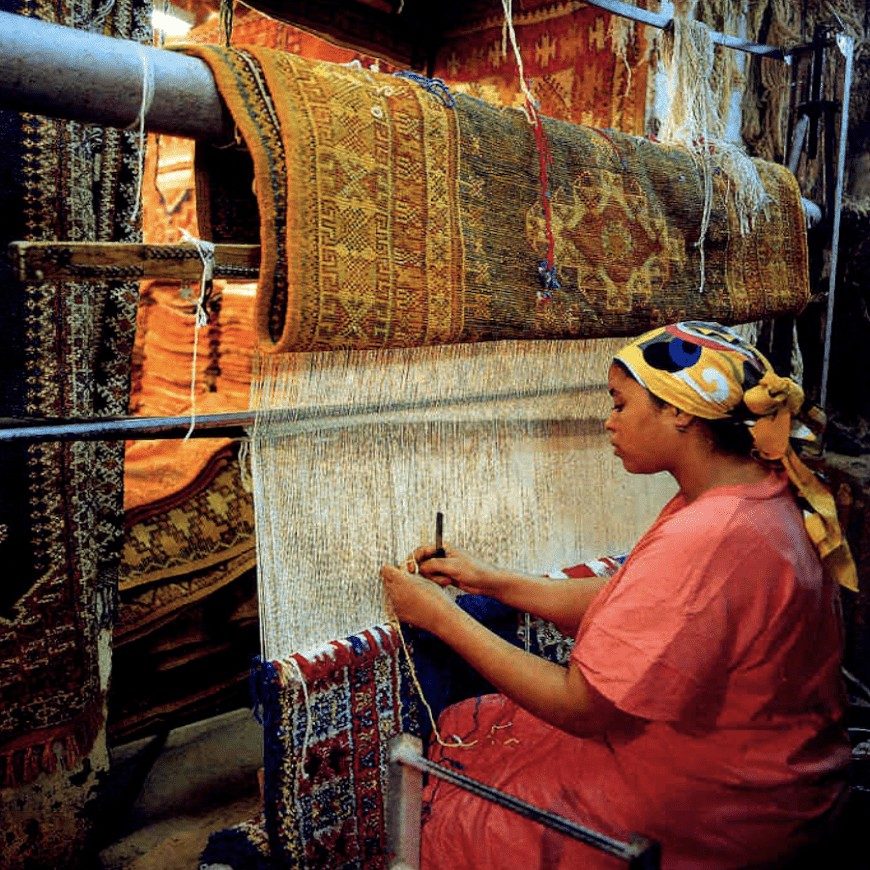
There's something special about watching a Moroccan carpet being made.
The sound of the loom, the colors of the wool, the patience in every movement. I've taken travelers into weaving workshops for more than twenty years, and it remains one of my favorite experiences to share.
But there's another side to the carpet trade that visitors don't always see.
Not every place calling itself a women's cooperative is necessarily what it claims to be. Some may operate more like privately owned businesses, where the women do the weaving but have little control over what happens to their work afterward.
I believe travelers deserve to understand the difference.
And more importantly, the women who create these beautiful carpets deserve recognition, respect, and fair payment.
When a Cooperative Isn't Really a Cooperative
Let me give you an example.
This is an illustrative, fictional story, not an accusation against any particular business. It shows how a misleading arrangement could work.
Imagine two entrepreneurs opening a carpet workshop in a Moroccan medina.
They rent a traditional house, decorate it beautifully, bring in several talented local weavers, and put a sign outside saying Women's Cooperative.
They create an attractive website filled with photographs of women working at their looms. Their social media talks about empowering rural women, preserving tradition, and supporting local communities.
To a tourist, everything looks wonderful.
But imagine that behind the scenes, the women receive only a fixed payment for each carpet. They don't own the business, they don't participate in its decisions, and they have no idea what their finished carpets sell for abroad.
The owners control the marketing, customer relationships, and profits.
The women provide the craftsmanship.
That doesn't automatically make the business illegal or unethical. Private workshops can provide valuable employment. The problem begins when a business presents itself as a woman-owned cooperative when it is not one, or makes promises about fair payment that it doesn't honor.
And this problem has nothing to do with whether the owners are Moroccan or foreign. What matters is honesty, transparency, and how the people doing the work are treated.
Why This Matters to Me
A Moroccan carpet isn't a factory-made souvenir.
Depending on its size, technique, and complexity, it can represent weeks or even months of careful work.
Many weaving skills are passed down through generations. Women learn patterns and techniques from their mothers, grandmothers, and other skilled members of their communities.
When you buy a handmade carpet, you're buying far more than wool.
You're buying time, knowledge, creativity, and a piece of someone's cultural heritage.
That's why I find it troubling when the people who make the carpets are invisible behind a polished brand.
It's also unfair to genuine cooperatives, where members work together, participate in decisions, and share the benefits of their collective activity.
Those cooperatives may not have impressive websites or large advertising budgets. Sometimes they don't even have someone who speaks English.
But their work deserves to be discovered.
Six Questions to Ask Before Buying a Moroccan Carpet
You don't need to become an expert in Moroccan cooperative law to make a thoughtful purchase.
A few simple questions can tell you a great deal.
1. Who Actually Owns the Cooperative?
In a genuine cooperative, the members are the owners. They take part in decisions and share in the benefits.
Ask who runs the cooperative. Is the president or manager one of the weavers? Do the women elect their leaders?
A friendly, open answer is a good sign. If the answers are vague, or if you only ever meet salespeople, ask more questions.
2. Is It Officially Registered?
Real cooperatives in Morocco are legally registered, and they can tell you their registration details.
You can politely ask for the registration number. A genuine cooperative will usually be proud to show it. If you'd like to check it, the Office for the Development of Cooperation (ODCO) is the public body responsible for cooperatives, and a licensed guide can help you understand how to verify one.
3. How Are the Women Paid?
Ask how the money is shared. Are the women paid per carpet, or do they receive a share of the profits as members?
There is no single "right" answer, because arrangements differ. What matters is that the answer is clear, honest, and fair.
4. Can You Meet the Weavers?
Look for places where you can talk to the women who made the carpets.
Ask their names. Ask how long a carpet takes and how they learned to weave. Even if you need a guide to translate, a real weaver will usually enjoy sharing her work.
If you can't meet anyone who weaves, or if the women seem to be kept apart from visitors, it's worth asking why.
5. Do the Prices Make Sense?
A large, finely knotted carpet takes enormous time and skill, and the price should reflect that.
Be careful if a handmade carpet is extremely cheap. Someone may not be getting paid fairly, or the carpet may not be handmade at all.
Also be careful if the price is very high and nobody can explain why. A beautiful shop is not a reason to pay triple.
6. Is the Story Too Perfect?
A polished website with beautiful photographs is not a bad thing. But look for real details: names of weavers, the cooperative's registration, where the carpets come from, and how to contact the group directly.
If everything sounds like marketing and nothing is specific, take your time before buying.
How to Buy a Carpet Fairly
Here are a few simple habits that help.
Ask your guide, and ask about commissions. Many guides are paid a commission by the shops they visit. That isn't automatically wrong, but you have the right to ask. I'm always happy to answer honestly.
Meet the maker if you can. The best purchase is one where you know who wove the carpet and where she lives.
Pay a fair price. Bargaining is part of Moroccan culture, and it can be friendly and fun. In a real cooperative, though, pushing the price too low usually comes out of a weaver's pay.
Ask for a receipt and a label. A good seller will tell you the carpet's type, size, materials, and origin, and give you a receipt.
Be careful online. If you buy a carpet from a website, look for named weavers, a contact address, and clear information about the cooperative. Ask questions by email before you pay.
What I Do With My Guests
When travelers tell me they'd like to buy a carpet, I never rush them.
I explain the different types, and I encourage them to ask questions. When possible, I introduce them to small family workshops and cooperatives where I know the people personally.
I also tell them it is perfectly fine to leave without buying anything. The experience of watching a carpet being woven is a gift in itself.
A carpet is more than something to put on a floor.
It's months of one woman's time, skill, and creativity. It should carry her name, and a fair share of its price.
If you'd like to include a visit to a weaving cooperative in your Morocco itinerary, get in touch and I'll be glad to arrange it.
You can also read my guide to Moroccan carpets and my article on argan oil and women's cooperatives.